
D.C.’s national park hidden in plain sight
WASHINGTON, D.C. — Rock Creek Park does not announce itself the way most national parks do. There is no towering entrance sign to welcome newcomers, no signature overlook that appears on postcards, and no obvious landmark signaling that a visitor has arrived.
Instead, Washington’s 130-year-old federal park sits quietly between neighborhoods, folded into commuter routes and edged by sidewalks that brush up against the forest. At first glance, it looks like a long stretch of ordinary urban woodlands.
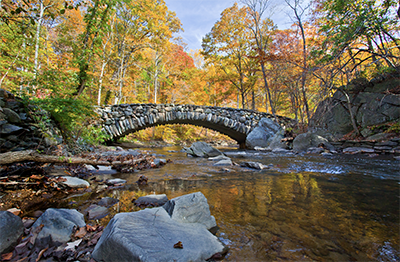 |
| Boulder Bridge in Rock Creek Park in the fall (Photo by Tony DeYoung, courtesy of the National Park Service). |
That quiet, tucked-away quality may be exactly why Washingtonians depend on it.
“People forget we are a national park site,” said Autumn Cook, public affairs specialist for Rock Creek Park. She has worked in the park for two years and commutes from Harpers Ferry.
For many people who live in Washington D.C., Rock Creek Park is not a destination. It is part of a routine. It carries commuters to work, runners through training seasons, parents pushing strollers, and cyclists who know every curve of Beach Drive.
Longtime runner and cyclist Matt Eisenstein has relied on the park for years. He spent more than a decade training for marathons along the park’s trails and often used Beach Drive as his commute route.
“There is nature, it is beautiful and there is not too much traffic,” he said. “It just goes on for a long, long time.” He returns most often to a route that stretches from the Pooks Hill area toward the National Zoo.
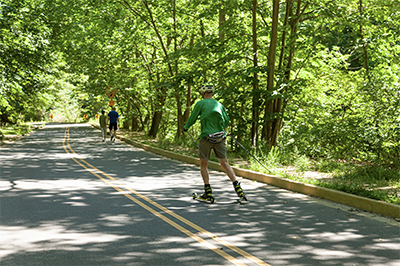 |
Skaters, runners, and walkers enjoy the roads and trails such as Beach Drive in Rock Creek Park (Photo by Kelsey Graczyk, courtesy of the National Park Service). |
Eisenstein also values the sense of calm the park provides.
“It is expansive. It is beautiful, serene, quiet, and tucked away, but very accessible if you live in D.C.,” he said. “Anytime you are training and you can find somewhere beautiful where you are not going to get hit by a car, it is good for both your physical and mental well-being. It is a perfect spot for all that.”
Although Rock Creek Park is one of the oldest federal parks in the country, created in 1890, it remains a place shaped mostly by people who live nearby.
“It is a gem,” Cook said. “A hidden one.”
That hidden quality comes with responsibilities. Cook spends much of her time helping neighbors understand how to use a national park in the middle of a dense city. Some issues repeat. Dogs off leash frighten wildlife. People swim in the creek despite posted warnings. Residents carve “social trails” through the forest, which damages fragile habitat.
“People think there is an easier way to get there, and they start doing that from their community or their apartment building,” Cook said. “The forest habitat is really fragile. Those social trails mess with that ecosystem.”
Forest health is one of the park’s biggest concerns. Cook said deer overbrowsing, invasive plants, more extreme storms, and ongoing erosion all make it difficult for new trees to grow.
| The Fish Ladder at Rock Creek Park (Photo by Thomas Paradis, courtesy of the National Park Service). | 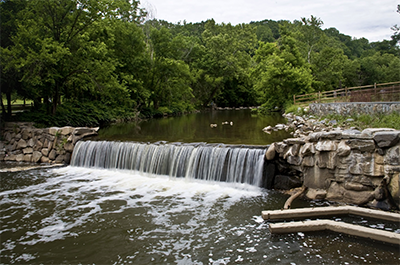 |
“The forest just needs a lot of help with growing the next generation of trees,” she said. Recent conservation efforts show just how urgent that help is. According to the National Park Service, the forested acreage of Rock Creek stores an estimated 100,000 tons of carbon, helping the city fight climate change while also cooling the urban heat island effect.
On hot summer days, the air under the trees can be as much as 17 degrees cooler than in surrounding neighborhoods. Those tall trees do more than offer beauty. They give relief, clean air, and quiet, natural refuge.
The park’s most important allies are volunteers, neighbors who care enough to get their hands dirty. Groups like the Rock Creek Conservancy help organize invasive plant removal, trail cleanups, and replanting native species. Their work restores native forest over areas degraded by invasive plants and human overuse, turning patches of harmed woodland back into thriving habitat.
Since 2019, Conservancy volunteers have removed nearly one million square feet of invasive plants from 30 acres of forest across the park.
“They are out doing it all the time,” Cook said. “People love this park and they volunteer because they care.”
Even with these challenges and constant work behind the scenes, Rock Creek Park remains a place where the city feels calmer. It is noticeably cooler than surrounding neighborhoods in the summer. The park offers spaces that feel almost rural.
The Rock Creek Park Nature Center and Planetarium houses exhibits on local plants and animals, live turtles and snakes, a bird observation deck, and a self-guiding Woodland Trail. It is also home to the only planetarium in the entire National Park Service, a place where children learn, families explore, and visitors pause to gaze at the stars.
Historic sites provide more reasons to explore. The park maintains the old grist mill known as Pierce Mill, a reminder of Washington’s early settlement era when settler mills ground grains harvested from surrounding countryside. Horse trails wind through remote sections.
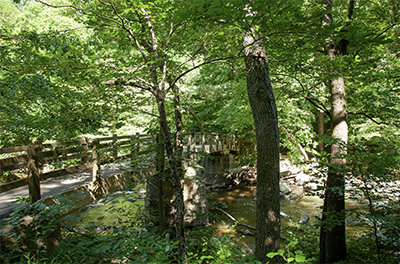 |
Summer foliage in Rock Creek Park (Photo by Kelsey Graczyk, courtesy of the National Park Service). |
Equestrian paths, paved bicycle lanes, footpaths, and even a golf course all share the park’s terrain, creating a complex web of spaces where different users find their own kind of sanctuary.
Cook believes the park’s greatest strength is the quiet surprise it offers. It does not push itself onto visitors, it does not expect grand displays. It simply holds space, wild space, in the middle of the city that never seems to slow down.
“It is a calm place and a place to rejuvenate,” she said. “Once you find it, it is a gem.”
Eisenstein agrees.
“You live in downtown D.C., and it is very easy to get to,” he said. “Once you are there, it is surprisingly nice.”
The surprise may be what defines Rock Creek Park. It rarely appears in travel itineraries and does not have the profile of more famous national parks. For the people who use it every day, including runners, families, volunteers, cyclists, and nature lovers, the park provides space to breathe, think, move, rest, and feel removed from the pace of Washington.
It is a national park hidden in plain sight, preserved not by tourists but by neighbors.
If You Go
Location:
Rock Creek Park stretches through northwest Washington, D.C., woven between neighborhoods from the Maryland border to the Potomac River. Entrances appear along Beach Drive, Military Road, Connecticut Avenue, Rock Creek Parkway, and many neighborhood paths.
Hours and Admission:
The park is open year-round from sunrise to sunset. Admission is free.
Visitor Centers:
- Rock Creek Park Nature Center and Planetarium
5200 Glover Road NW
Features exhibits on local wildlife, a bird observation deck, live animals, and the only planetarium in the entire National Park Service.
Check ahead for planetarium program schedules. - Peirce Mill
2401 Tilden Street NW
A restored nineteenth-century grist mill that offers a look into early Washington history. Hours vary.
Best For:
Running, cycling, strolling, picnicking, birding, horseback riding, and finding quiet in the city. Beach Drive is closed to cars on weekends, which makes it a popular route for cyclists and runners.
Getting Around:
The park is large and winding. Trails range from paved multi-use paths to rugged forest routes. Cell service can drop in some sections, so consider downloading maps before visiting.
What to Know:
- Dogs must be leashed to protect wildlife.
- Swimming in Rock Creek is prohibited.
- Stay on marked paths to avoid damaging fragile habitat.
- After storms, some trails may be muddy or temporarily closed due to erosion.
How to Help:
Volunteer with Rock Creek Conservancy. Activities include invasive plant removal, trail cleanup, and native plant restoration.
Why Go:
Rock Creek Park offers cooler air, dense forest canopy, historic sites, and a surprising sense of escape within Washington, D.C.
Comments are Closed